Core principles
I've thought about the AI controversy a lot, and wanted to spend the time to properly articulate my thoughts. To help do this, I decided to codify what I think the core direction and principles of Cavey are, so that they can inform me how Cavey should be developed in the future.
1. Cavey is a personal project of passion.
This game is not any other game that you would ship to market. It is instead a personal expression of the kind of game that I specifically want to see in the world, informed by my nostalgia and opinions on the games that I played growing up. I am making this game for myself, and I am the target audience.
If I lose interest in the project, I should not outsource development to an AI, or to anyone else. I should instead allow myself to leave the project in the state that it is in, and to move on to other things that I am more passionate about. Without my voice in the project, it would not have any special reason to exist, and would very likely lose its opinion and soul.
2. Cavey is about the details.
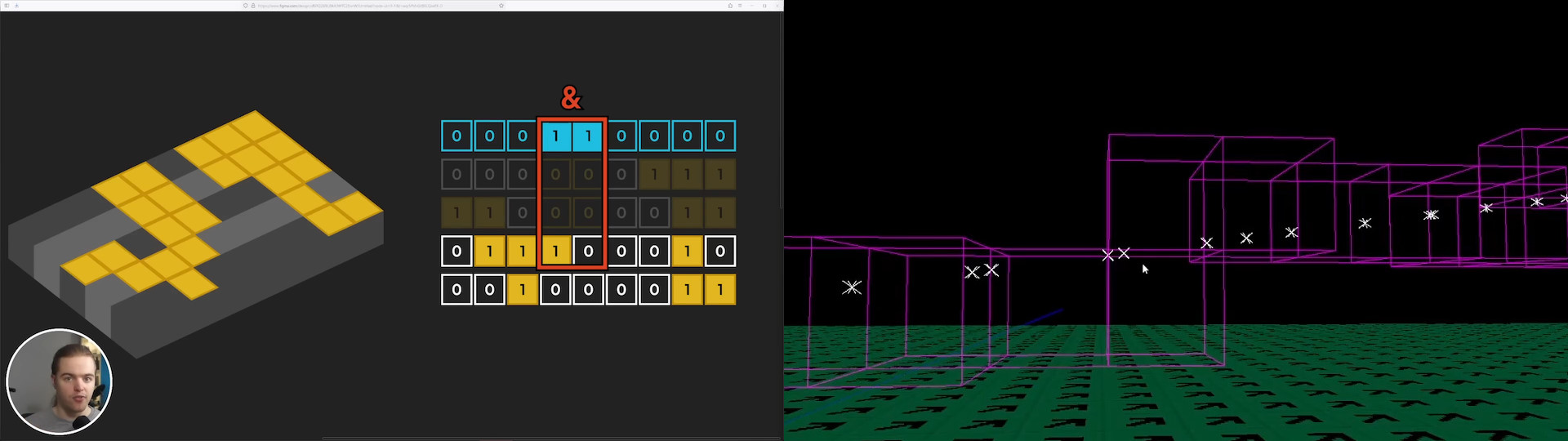
I've pored over the code, algorithms, profiles and RenderDoc captures of Cavey for years. I care about the game at the lowest technical level, up to the highest artistic level. I'm not above rearranging the way voxel data sits in memory, or spending months working on music tracks for the game's soundtrack. They may not be directly quantifiable but I believe it is these details that bring Cavey legitimacy as a game worth playing. The game must feel responsive under the hand, look smooth upon the eyes, and feel balanced as you play.
I don't want to sacrifice these details on the altar of productivity. Even when it makes more business sense to move on to the next feature, or to leave something underpolished, I often ignore the common wisdom and work on it anyway. Cavey generally is not a project of efficiency, but of care and attention, and that's a core proposition of the game. Current-day AI tools require serious coaxing to prioritise the same.
3. Cavey is a way to teach others.
This is not a project that I am doing to make money. I am doing it to learn, and to share what I learn with others. I want to help other people make games like this, and lift up other projects in the space. When I spend hours refining algorithms or debugging performance pitfalls, those are things I can contribute back to help guide others who find themselves in the same place.
When I take on more work, I can share more work. When I understand what's going on from a new perspective, I can share that perspective. Even though the project is closed-source, it's open-knowledge, and it's what I think is best for the voxel game development scene.
Where AI lands with these principles
The simple truth is that many of the current AI vendors promote a hands-off philosophy, focused more about obtaining end products than about elevating the human doing the work. This is not how I want to use AI. I want to use AI as a tool that I can control, that can help me with specific tasks, but that does not take away from my ownership and artisanship of the project.
I'm not inherently against the technology of matrix multiplications producing stochastically useful outputs. That'd be like being against the concept of addition. I'm against the way that the current market of AI tools is structured, which encourages you to hand off work to a black box and hope for the best. I want to be able to open up the hood, understand how my code works, and have a say in how my code works.
Indie programming is at its best when people can connect through the design and construction of the projects they share with the world. Part of the reason I'm writing these words by hand is because I want to connect with others through them. While I fully believe and advocate for Cavey being appreciated as a standalone work devoid of the artist, that doesn't mean it isn't inherently also a product of the artist. That's why the tools and thoughts I use to build the project matter.
How Cavey does not use AI
AI is not used in an undirected capacity for coding ('vibecoding'), or for generating music or art.
That means that I architect every algorithm and call every shot on technical decisions. I grok and understand how the game technically works at the same deep level I have always done. AI can write boilerplate for me, or look up physics equations, or even help with some mathematical reasoning at times, but it does not get to make any of the core decisions. That has always been my job, and according to these principles, it should be.
AI is not a replacement for my creativity. It remains firmly in the assistive seat, helping but never replacing my voice. That is where I draw the line on AI use in Cavey.
I have played around with tools like Claude Code to see what they are capable of; they can be helpful for certain tasks, but they are not a black box that I can hand off work to without thought. They are not a magic bullet, and I don't treat them as such. Anything that is produced by Claude is subject to the same scrutiny and standards as anything that is produced by me, and if it doesn't meet those standards, it doesn't go in the game. That means extensive profiling, editing, testing, and oftentimes complete reworking. It does not save me time, and it does not save me work. It is just a tool that lets me do the work in overspecified English, which does not accomodate losing concept of what the program does.
I have also played around with other tools that generate images or music. These are even less convincing to me; I am incredibly protective of my creative style and I am very particular about what passes my quality bar. Simply put: these tools don't produce anything worth incorporating, so it's still easy for me to reject these outright. They are not a part of my process. I still draw every pixel, tune every FM synth, and play every piano note by hand, just like I always have done. To some degree, I suspect these will never be good enough for Cavey, as the human touch in the music and the art is what makes it uniquely compelling, even in its alien soundscape and with its clean pixel style.